Showing posts with label Patagonia. Show all posts

Saturday, 18 December 2010

Road trip to Estancia Harberton, Ushuaia


With our fine friends from the Beaver state - Oregon, USA, we rented a car and set out on a 100km drive down the coast from Ushuaia to Estancia Harberton. This farm was established in 1886, when the British missionary pioneer Thomas Bridges (1842-1898) resigned from the Anglican mission at Ushuaia, and was given 20,000 hectares of farm land at the very tip of Tiarra Del Fuego. 

The estancia was named after Harberton, Devon, the home of Thomas wife, Mary Ann Varder (1842-1922). Bridges was the author of a dictionary of the Yamana or Yaghan language, and their son Lucas Bridges (1874-1949) wrote 'The Uttermost Part of the Earth'' about his boyhood, the Yamana, and the family's adventures in getting the dictionary published in Europe.

Tommy Goodall (born 1933), is Thomas Bridges’s great-grandson, who still manages the estancia with his wife, American biologist Rae Natalie Prosser, with help from their daughter and her children. We we're taken on a tour of the estate by his grandson, also called Thomas (there is one in every generation), and it was a wonderful trip down memory lane, this place could have been a seaside house in Cornwall.

In fact the house itself was shipped as a wedding gift from Mary Ann Varder's family and was declared a national monument in 1999. They have a cute English tea room and little brick outbuildings, and an amazing garden planted with fruit trees and lupins. The huge sperm whale jaw used to create an arch over the garden gate is a reminder to the location of this outpost and the delicate wildlife both on the land and in the sea.

One of the surprise highlights of the trip, was a visit to the Museo AcatushĂșn de Aves y MamĂ­feros Marinos Australes (Dolphin and Seabirds museum) just 500m from the main house. It is a working Museum/laboratory for the study of the basic biology of the marine mammals (mainly dolphins) and birds of the southern tip of South America. The result of over 34 years of scientific research by its founder, Natalie Goodall, the wife of Tommy Goodhall, the collection contains the skeletons of over 2700 marine mammals and 2300 birds.
All the skeletons have have come from animals found washed up and dead on the shores of Tiarra Del Fuego and Antarctica.

They are painstakingly stripped on their flesh in the 'BoneHouse', a brutally deathly house of bubbling blubber and bones. They are then catalogued and prepared by researchers from all over the world, who come here to intern and work with Natalie. They are sponsored by some big local oil players - Mobile and Total, but receive most of their income from donations. We spent an enlightening hour being show these amazing mammals by a super knowledgeable intern from Mar Del Plata. Check out the pics of the seals, they have four limbs just like humans, you wouldn't think the floppy tail of a seal contained two limbs!

Sailing the Beagle Channel - Argentina


The Beagle Channel separates Tierra del Fuego with the extreme south of South America and Chile. It's so named after HMS Beagle, the ship we brits sent to do a study of navigation channels to try and gain a trade advantage over the pesky Portuguese and Spaniards way back in 1826.


The Beagle was captained by FitzRoy who took Charles Darwin along for the ride - both now have islands down in Antarctica named after them and Fitz Roy also has a whole mountain up north to his name! When they reached the Beagle channel on 29 January 1833, he wrote "many glaciers beryl blue most beautiful contrasted with snow.''
From Ushuaia, that's exactly what we thought when we set sail out into the icey waters of the Beagle and embarked on a long voyage to H Island, the southern most tip of Argentina. H Island is one of many settlements used by the Yamana people for shelter and food over 10,000 years ago, today its a wildlife sanctuary and is a haven for Cormorants and Wild geese. Indeed we saw hundreds of nesting pairs with their new babies, surviving the brutal wind , powerful sun and ice cold snow.
Before H Island we were treated to a close encounter with a very large colony of seals, they lounge around on the rocks all day before going into the sea to gorge on shrimp and king crabs. We found out later that these amazing mammals go out to fish in the deep ocean trenches at the very edge of the continental plates, and can swim at depths of up to 2000m. Amazing.
This was Maudies first experience on a proper sail boat and she loved it as the mighty winds kicked in and pushed the vessel to a 30 degree angle with the water, I on the other hand was a little scared about falling in the ice cold Antarctic waters.... but put on my bravest face and stiffed my upper lip in homage of Cpt. Fitz Roy.


Friday, 10 December 2010

Chile - Patagonia - Torres Del Paine National Park


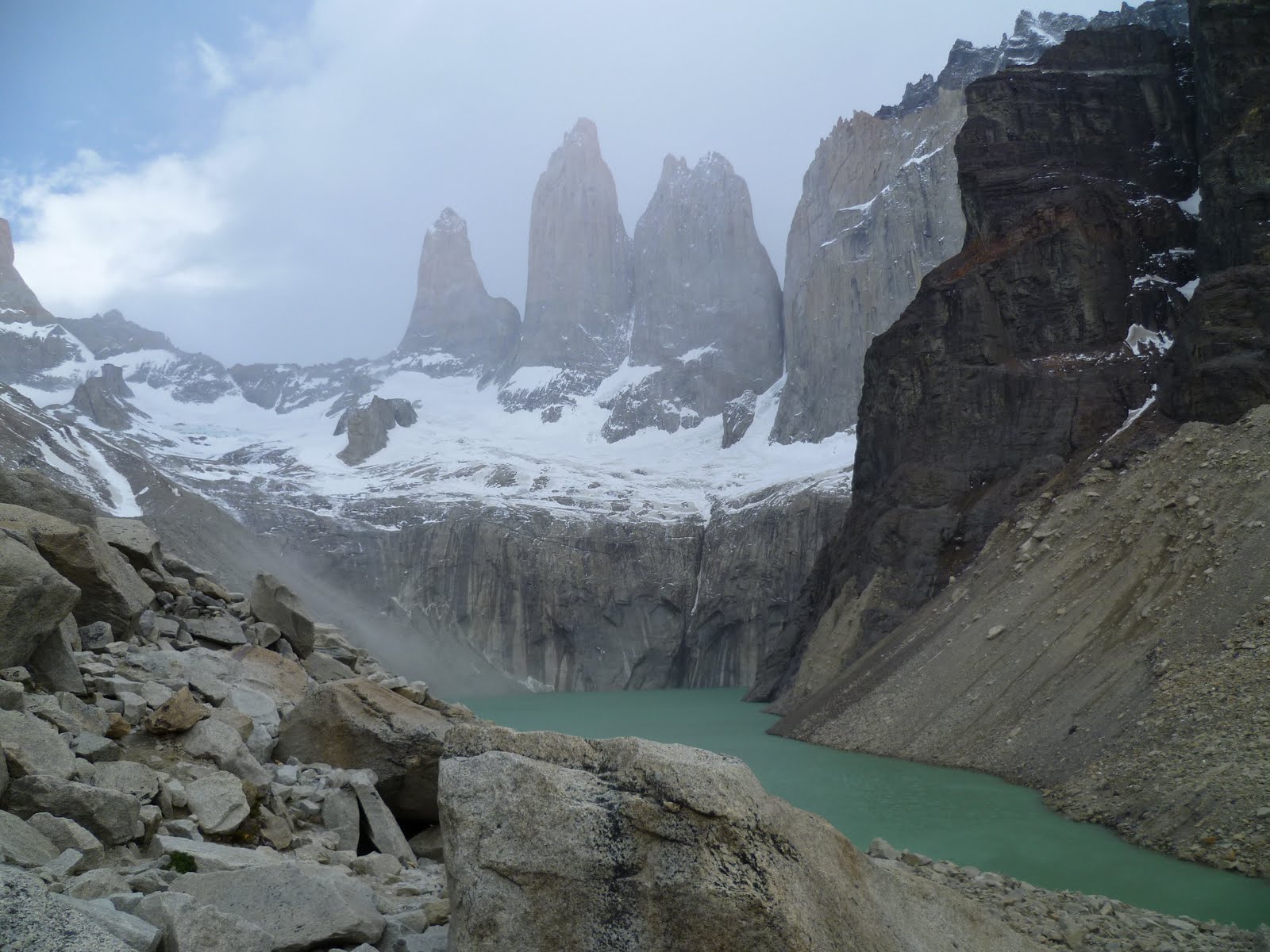
Lady Florence Caroline Dixie (24 May 1855 – 7 November 1905), was the first tourist to the park alongside the British party whom accompanied her and in her book of 1880 she described the three towers as 'Cleopatra's Needles' - know known as the Torres del Paine.

It must have been amazing for her coming from Victorian England to see the Southern Patagonian Ice field and the huge glaciers: Grey, Dickson and Tyndall. Also the huge lakes with their vivid colours due to the rock flour from the glaciers suspended in their waters.

Why? Because even today we we're absolutely flabbergasted and the internet and magazines show it in glorious color. It's a very long way from the English hills and countryside, the flowers, lakes, animals and weather are out of control. They say you get four seasons in every day in Patagonia and it's true - sun, snow, rain, wind - all pushed to the limits. Blazing hot, super cold, huge 90mph gusts of wind, horizontal rain. There really is something not right about this place, yet it holds itself together and 000's of people come to see it every year.

Being extremists when it comes to pushing the limits, we set out to do both the Circuit route and the 'W' - both should take around 10 days. We did 135km in all conditions in just 5 nights, a brutal exhibition of endurance and solidarity - we hiked and climbed with all our food and gear on our backs.

Day one took us to the mighty Cleopatra's Needles, and camping in the woods. Sunrise didn't bring National Geographic style photos of the towers lit up in red early morning sunshine, but the snow capped trek to the summit and views of sunshine washed rock were moving!

Day two took us around the right side of the park, in the lowlands and grassy valleys following bright blue and turquoise rivers to a wonderful grassy camping spot called Seron.

Day three pushed us through the valley to largo Dickson and the mighty glacier, then through the steeply sided forest valley past crashing waterfalls and wind ripped trees to campsite Los Perros, in the shadow of a huge ancient glacier perched 1000m up on the mountain side.

Day four was not for kids. We had to push ourselves up through the notorious John Garner pass, a snow and rock swathed landscape with winds of up to 100mph pushing us over razor sharp jagged rocks and rivers of fresh glacial water. At the summit we were rewarded with the most amazing view of our lives - the Grey Glacier, a solid landscape of ice frozen for an eternity and stretching some 10km across the valley, and up it as far as the eye could see. As the ice reached largo Grey, huge icebergs would break off and float about the blue lake like marshmallows atop hot chocolate.

Day five took us all the way along lago Grey to the second valley on the W and camp Italiano, on route we bumped into some of our friends from treks in Bariloche! we're going to try and hook up in Ushuaia (next stop down near the Antartic). The views of the lakes really are special and everytime you look up, seeing the snow capped peaks feels mysterious and special. After walking 22k and setting up camp at Italiano, we decided to do the 12k round trip up the valley to see Glacier Francia and the windswept views of the towers from the other side. The views down the valley of the lakes and the towers at sunset were beautiful.
Day six was the home straight, tired, cold, exhausted and looking forward to home we set off on the 18km walk around lake Nordenskjold at 8am to get the 2pm bus back to Puerto Natales, once on, it was only a matter of seconds before we passed out....

Torres del Paine National Park - what an adventure